The Moon
Phases, Eclipses & Tides
Lesson
- Moon Lesson (PDF) — 15-slide deck illustrated with NASA photos: Earth’s satellite, its distance, its seas and craters, how it formed, the phases, the far side, eclipses of the Moon and of the Sun, tides, and the trips to the Moon, from Apollo 11 to Artemis II
Interactive Simulations
- The Phases of the Moon — drag the Moon around the Earth, seen from space, and watch its shape change, seen from the Earth: the name of the phase, how much is lit, when it is in the sky, tonight’s Moon, the Northern or Southern Hemisphere, and a challenge: place the Moon on its orbit from its shape
- Ground Gravity Lab — drop a ball on the Moon, then on Earth, and compare: gravity there is six times weaker
For teachers and the curious
Source Code
- moon-phases.js — the phases simulation: the Moon on its orbit, the lit part seen from the Earth, and tonight’s phase, counted from the new moon of 6 January 2000 with the average length of a lunar month, 29.53 days (J. Meeus, Astronomical Algorithms)
Sources
- NASA, Moon Fact Sheet — NSSDCA, NASA. The figures in the lesson: diameter, mass, gravity, average, shortest and longest distance, length of the orbit (27.3 days) and of the lunar month (29.5 days), tilt of the orbit.
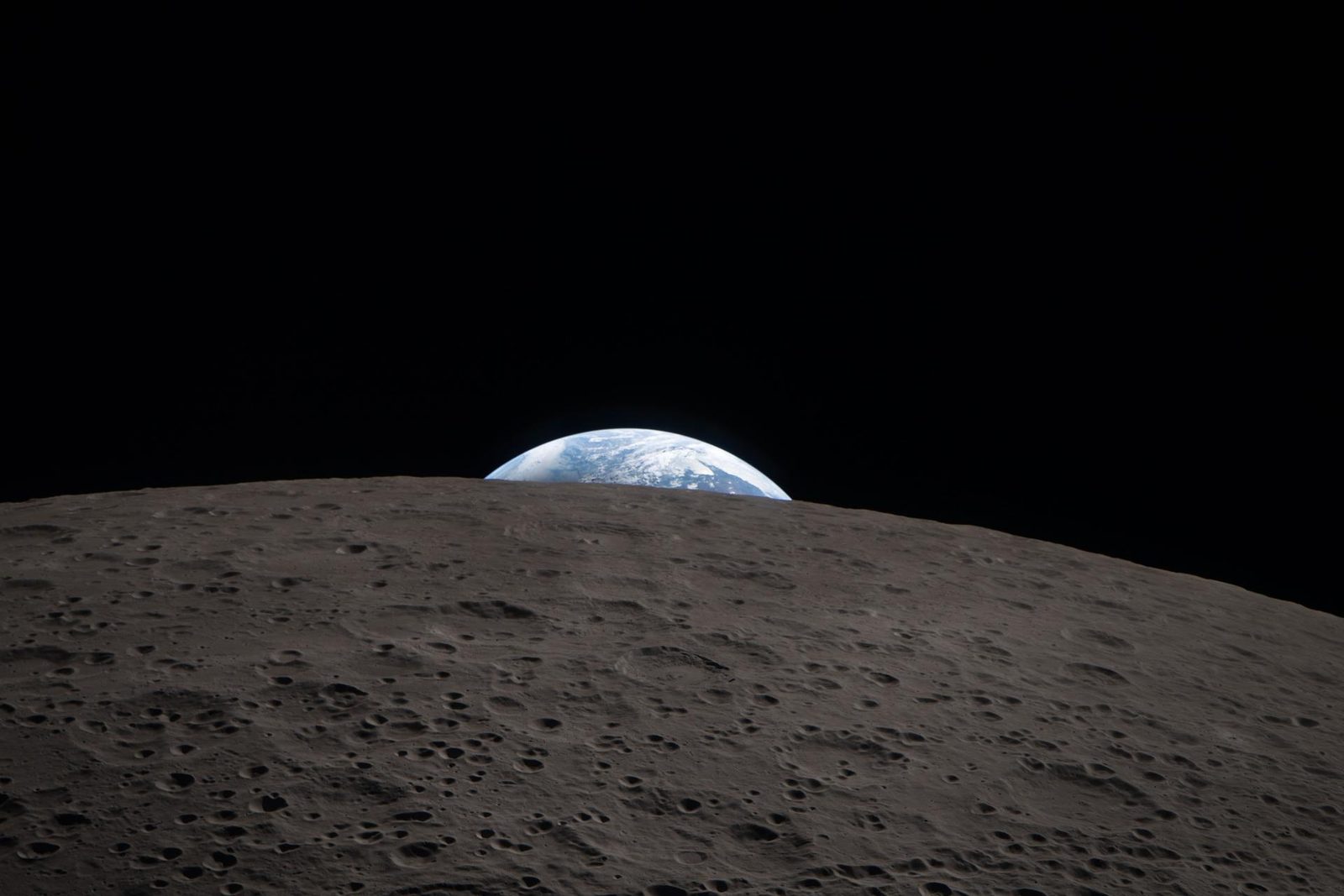
- NASA, Image and Video Library — The lesson’s photos, in the public domain: Apollo 8’s Earthrise, Buzz Aldrin and a bootprint from Apollo 11, Artemis II’s Earthset, the eclipses of 8 November 2022 and 8 April 2024, the far side seen by the LRO probe (NASA/GSFC/Arizona State University), and the phases rendered by Goddard’s Scientific Visualization Studio from LRO’s measurements. The list is in CREDITS.txt.
- NASA, Artemis II Crew Eclipses Record for Farthest Human Spaceflight — The Artemis II flight, from 1 to 10 April 2026, and the distance record of 6 April.
- NASA Science, Moon Facts — The temperatures near the Moon’s equator: up to 120 °C in sunlight, below −130 °C in the dark.